
Realistic by design: How Argentina aligned health reform ambition with reality
Editor’s note: Health reforms sometimes fail not for lack of vision, but because ambition runs ahead of what systems can realistically implement. In this second blog in R4D’s series on realistic health system design and planning, we apply that insight to Argentina’s Programa Sumar — examining how a complex, decentralized health system translated reform ambition into sustained frontline change. The first blog introduced the full framework of enabling factors for realistic planning. Read it here.
In many low- and middle-income countries, planning for primary health care (PHC) unfolds in volatile financing environments, with fragmented governance arrangements and competing political priorities. When annual plans are based on historical norms or unrealistic targets, a persistent “reality gap” can emerge—between what is promised, what is financed, and what can actually be delivered. But by aligning its health reform with institutional realities and navigating complex power dynamics, Argentina turned an “on-paper plan” to a functional reality at the frontline.
Context: A decentralized public health system and a window of opportunity
Argentina’s public health system is highly decentralized. Provinces are responsible for service delivery, while revenue collection remains centralized, and the national Ministry of Health (MoH) has limited formal authority over provincial health systems. This has created a persistent misalignment: the national government is politically accountable for health outcomes it cannot directly manage, while provinces face wide disparities in fiscal capacity, fragmented information systems, and weak incentives to prioritize PHC.
The central government’s policy challenge, therefore, is to influence service delivery across provinces — improving effective access, efficiency, and accountability — without altering institutional arrangements or taking direct control.
Argentina’s severe economic crisis in 2001 created a window of opportunity to tackle this challenge. Rather than pursuing sweeping legal or constitutional reform, the national government took a more pragmatic path — mobilizing modest, incremental resources and transferring them to provinces to strengthen their purchasing capacity and expand health coverage. The results-based maternal and child health program, known initially as Plan Nacer, was launched in 2004.
And the approach worked. Impact evaluations documented meaningful gains in priority service utilization and maternal and child health outcomes (Gertler et al., 2011; 2014). Building on this success, Plan Nacer was renamed Programa Sumar in 2012 as its scope expanded to broader populations and services.
More than two decades later, Programa Sumar remains in operation — an example of sustained reform in a complex, decentralized system.
Designing within existing institutions — and building provincial ownership
Programa Sumar was designed as a targeted financing approach to strengthen effective coverage for the uninsured population, with a strong initial focus on PHC. Its ambition was to strengthen strategic health purchasing to improve the delivery and accountability of a defined health benefit package across provinces.
Although modest in scale — mobilizing around one percent (1%) of provincial public health spending, Sumar distinguished itself by linking resources to results — such as pregnancy care, child check-ups, cancer screening, and chronic disease management.
A critical enabling factor was the early and sustained involvement of provincial governments in the program’s design, primarily through the Federal Health Council. Rather than imposing a “fully baked” model, the national Ministry of Health shared design objectives and principles through ongoing exchanges and encouraged provincial analysis of feasibility. This participatory process fostered ownership and enabled adaptation to diverse provincial contexts.
From the outset, the program was based in existing structures. Provinces retained full responsibility for service delivery, while the national level used predictable, results-linked transfers to strengthen purchasing arrangements and reinforce accountability for what services were actually delivered. Financing thus acted as a governance lever — bringing together objectives, incentives, and implementation routines across levels of government.
Linking resources to results: How federal transfers made reform work in practice
At the heart of Programa Sumar is a financing intervention that uses federal funds transfers to shape how services are delivered across provinces.
Instead of reinforcing traditional input-based budgets, Sumar links federal funding to verified performance — the delivery of services included in an explicit PHC-oriented health benefit package. It makes clear exactly what the provinces are expected to deliver, how progress will be assessed, and how resources follow demonstrated outputs. Health facilities record and report priority services — such as prenatal care, child health check-ups, or chronic disease follow-ups — while provincial management units routinely verify these records through audits and cross-checks before payments are made.
Funding is allocated from the national to the provincial level through a transparent formula combining equity and performance criteria — directing more resources to those provinces with greater needs, while rewarding improvements in priority PHC outputs. Funds can only be used to purchase the defined package of services from public providers, through performance-oriented payments that supplement historical budgets. Health facilities, in turn, have autonomy to allocate these resources based on local needs.
To operationalize this model, Programa Sumar created national and provincial management units that led implementation. These units have since become a lasting part of provincial health ministries, building management capacity that has endured beyond any single reform cycle. Supported by standardized procedures, technical assistance, supervision, and performance agreements, this approach has translated financial incentives into sustained improvements in management capacity — building lasting “managerial muscle.”
Thus, Sumar used the “policy lever” of federal transfers to connect national priorities with provincial execution capacity, while preserving decentralized autonomy over local service organization.
Scaling smart: How Programa Sumar expanded adaptively
Programa Sumar expanded over roughly a decade, starting with a deliberately narrow scope — prioritizing services for mothers and children in the most disadvantaged provinces. Expansion was deliberately sequenced: starting where needs were greatest, then scaling geographically and across population groups as capabilities, provider engagement, and information systems strengthened — eventually covering all Argentines that lacked formal health insurance.
The gradual expansion of Programa Sumar (2004 to 2026)
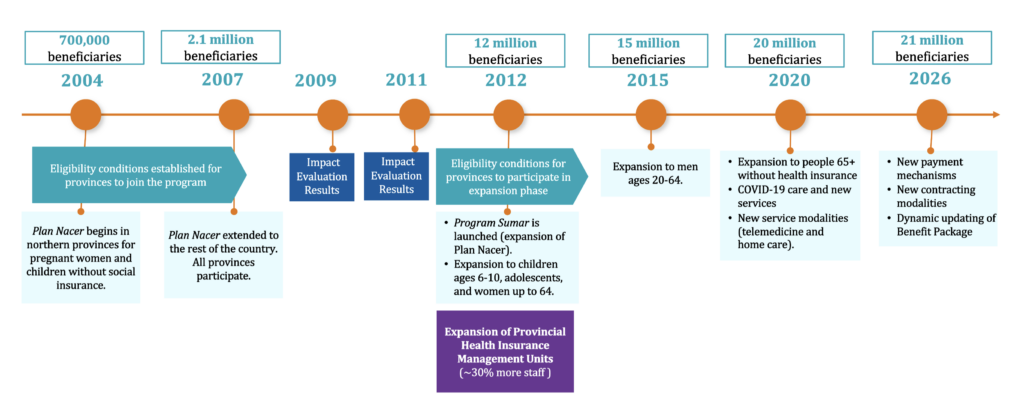
A defining feature was the balance between national-level rule-setting and provincial flexibility: the federal Ministry of Health established core policy parameters, while provinces retained discretion over implementation. Importantly, this expansion was not driven by incentives alone. Close supervision and tailored technical assistance ensured that greater provincial autonomy translated into stronger management, without widening inequities. Federal teams supported provincial units in developing plans, routines, and results-oriented tools. As provincial capacity grew, the program expanded across population groups and services — including higher-complexity interventions. This stepwise approach reduced political and operational risk and allowed learning and course correction without losing strategic direction.
The core policy approaches evolved alongside implementation. Sumar did not start with sophisticated digital systems or fully costed benefit packages; these capabilities were deliberately built over time as operational needs became clearer and execution capacity grew. Health information systems — strengthened through incentives rather than mandates — helped embed a results culture. They paved the way for future program evolution and broader system effects.
Over time, the program scaled nationally to cover more than 21 million people and over 700 services — illustrating a core realistic system design principle of careful sequencing, institutional learning, and sustained implementation.
The three pillars that turned Programa Sumar’s vision into reality
Programa Sumar represents the deliberate alignment of a long-term vision and operational execution over time. Rather than relying on a single policy instrument, the reform evolved through an integrated institutional architecture linking political priorities, strategic design and operational planning. Alignment was actively built through rules, organizations, relationships, and learning systems that translated ambition into implementable practice.
This approach rested on three mutually reinforcing pillars:
- Clear and enforceable rules — defining eligibility, benefit entitlements, payment arrangements, verification mechanisms, and fiduciary controls — established a normative and procedural foundation.
- Dedicated national and provincial management units served as an organizational and managerial platform, and built the core competencies needed for implementation.
- A culture of collaboration between federal and provincial governments, where provinces acted as co-designers and co-implementers of the reform, fostering shared ownership and accountability across a decentralized system.
Programa Sumar also embedded a strong learning and evaluative culture from the outset. It used monitoring, audits, and evaluations as core governance instruments that fed back into program evolution and continuous improvement.
What Programa Sumar demonstrates about realistic design and planning
Viewed through the lens of realistic health system design and planning, Programa Sumar illustrates that effective reform does not require perfect initial conditions — it requires starting from what is feasible and building capacity through implementation. It demonstrates how reforms can:
- align goals, financing, and managerial capacity;
- strengthen existing institutions rather than redesigning systems from scratch;
- scale ambition pragmatically and adaptively;
- foster shared ownership among stakeholders; and
- use information and results to sustain learning and future reform.
For policymakers and partners, Programa Sumar shows that realistic planning is not about lowering ambition, but about sequencing it — bridging long-term strategies with operational practice through institutions, processes, and tools that make reform executable, adaptive, and durable.