
How AI is helping countries analyze health data in hours, not weeks
As global health aid and economic conditions become more volatile, ministries of health are being asked to do more with less at a faster-than-ever pace. This has created an urgent need for rapid data and insights into how these disrupted financing flows, as well as other global shocks such as fuel crises, fragility and insecurity, and the impacts of climate change, are affecting populations’ use of health services. Decisions that used to take months must now be made in weeks – but the data infrastructure to support that change hasn’t kept up.
That’s the context in which the Global Financing Facility’s FASTR initiative operates — and it’s what brought health data practitioners from seven countries to Abuja, Nigeria in February 2026.
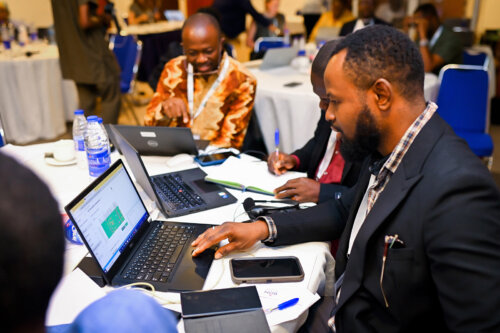
Participants at the Global Financing Facility’s FASTR initiative Multi-Country Learning Exchange in Abuja, Nigeria in February 2026.
The Global Financing Facility’s (GFF) Frequent Assessment and System Tools for Resilience (FASTR) initiative supports countries to routinely generate, analyze, and use service delivery data to strengthen primary health care (PHC) and improve reproductive, maternal, newborn, child, and adolescent health and nutrition (RMNCAH-N) outcomes. FASTR’s web-based, open source, and AI-enabled analytics platform is enabling countries to rapidly quality-assure, analyze and visualize their existing administrative data, driving new insights to improve PHC and RMNCAH-N performance.
A new Multi-Country Learning Exchange series is bringing together country teams from over 25 African countries through in-person workshops and pre- and post-workshop webinars to strengthen analytic capacity, peer-to-peer learning, and action planning that drives use of data to strengthen health systems. Participants came together around a common question: How is service use changing in response to changing funding for the health sector and ongoing reforms and are there any key service delivery disruptions that need urgent mitigation?
By the end of the three days, country teams had generated customized service disruption and utilization reports – facilitated by FASTR’s new AI features.
The results were striking: in the words of a participant from Burkina Faso, reports that would usually take weeks to prepare could now be prepared — with quality-improved indicators — in only a couple of hours. This increased efficiency allows for critical decisions to be made at a more rapid pace and with more confidence in the quality of the data being presented. Perhaps most critically, the analytics platform’s friendly user interface and AI assistant enable decision-makers to generate complex statistical analyses themselves, all at the click of a button. This keeps data in the hands of country owners and users, minimizing unsustainable reliance on external consultants and empowering country champions to generate the analysis they need, when they need it, within their own windows of opportunities to use data to enhance decision-making.
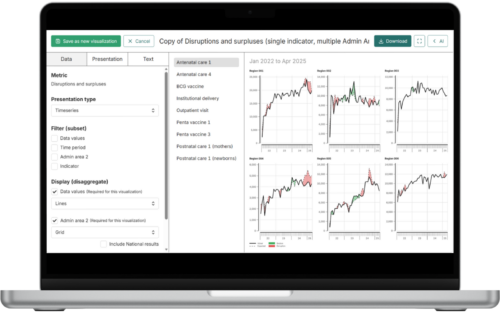
Example service disruption and utilization report facilitated by FASTR’s new AI features.
Following the workshop, countries have taken FASTR forward in their respective contexts to support a diverse set of decision-making needs. In Burkina Faso, these new FASTR champions have already used FASTR reports to guide resource prioritization and present findings at their national Health Financing Forum held in March 2026. In Zambia, the FASTR platform is going to be used by the President’s Delivery Unit (PDU) to track key HIV, TB, and malaria indicators associated with the presidential priorities.
“We are all happy and excited about working with this [FASTR] platform, because when it comes to data analysis back home, especially looking at our country context, we’ve had issues with […] reporting our data adequately to actually capture what specific issues need to be addressed. “ – Georgia Tammy Mitchell Quaye, Liberia Government Country Coordinator.
As countries continue to institutionalize this work, they will have access to hands-on technical support from Results for Development (R4D) and GFF team members throughout their learning journey via webinars and office hours.
In today’s poly-crisis environment, countries around the world are experiencing major disruptions to their health systems. Those that will be able to adapt and preserve the health of their populations have the right tools to efficiently collect and analyze data, quickly making informed decisions. The FASTR initiative, along with its accompanying analytics platform and AI-enabled capabilities, represents a meaningful step toward that reality at country level.
As these first seven countries take bold steps forward to face the current challenges head-on and strengthen their data use eco-system, they will be equipped to serve as mentors and coaches for new countries coming on board the platform.
Looking forward, the R4D and GFF teams will host new countries in two more workshops as part of this multi-country learning exchange, set to take place in Dakar, Senegal and Addis Ababa, Ethiopia in April and June 2026, respectively.
In a world where the clock is always ticking and opportunities for additional resources are harder to come by, FASTR is equipping countries with the necessary tools to make timely, evidence-informed decisions, ultimately seeking to drive improvements in health outcomes faster than ever before.
Related resources
- Learn more about the GFF’s FASTR initiative at: https://data.gffportal.org/key-theme/FASTR
- Learn more about how R4D is supporting the GFF in its implementation of FASTR at: https://r4d.org/projects/improving-health-outcomes-women-children-adolescents-fastr-rapid-cycle-data-use-initiative/
- Explore a sandbox of the FASTR analytics platform at: https://demo.fastr-analytics.org/
Acknowledgements
GFF and R4D acknowledge the Nigeria Federal Ministry of Health and Social Welfare for hosting the convening. We acknowledge the generous support from the Global Financing Facility for Women, Children, and Adolescents, the Gates Foundation and the New Venture Fund (NVF) for these Multi-Country Learning Exchanges.