
R4D Nigeria

Assessing the impact of U.S. government funding cuts on immunization programs in DRC, Madagascar and Nigeria
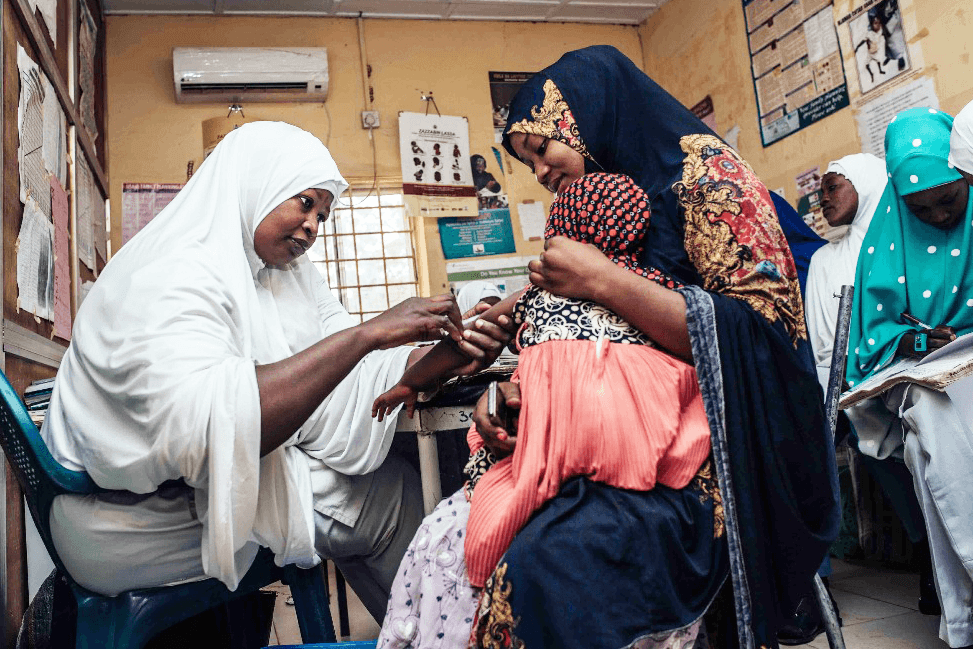
Child in Madaratul Nurul Huda school in Kaduna, Nigeria

31, Adamu Ciroma Crescent, Jabi, Abuja, Nigeria

Capabilities and Work

Health Financing

R4D Nigeria works with federal and state leaders to design and implement equitable health financing systems that expand access to care and reduce out-of-pocket spending. Through close collaboration with ministries of health, national and state primary health care agencies, and health insurance institutions, R4D helps translate national health priorities into practical financing policies and programs.

R4D has played a key role in strengthening the implementation of Nigeria’s flagship pro-poor financing initiative, the Basic Health Care Provision Fund (BHCPF), which expands funding for primary health care services across the country. The team has supported national institutions including the National Health Insurance Authority (NHIA) and the National Primary Health Care Development Agency (NPHCDA) to strengthen program management, financial oversight, and implementation systems.

Building on this work, R4D currently supports the Nigeria Primary Health Care Technical Assistance program, helping government partners consolidate and expand recent reforms. This includes supporting efforts to integrate vertical programs into the Basic Minimum Package of Health Services, strengthen public financial management and budgeting processes, redesign the BHCPF to align with evolving health sector reforms, and expand strategic purchasing and insurance coverage. R4D also conducted a gender analysis to inform the redesign of BHCPF 2.0, ensuring the program better addresses the needs of women and vulnerable populations.

R4D also supports Nigeria’s immunization ecosystem by advancing sustainable domestic financing approaches, strengthening accountability mechanisms, and improving coordination among government and development partners.

Leadership Capacity Strengthening

R4D Nigeria works with government partners to strengthen the leadership and management capacity of officials responsible for delivering and financing health services, while also supporting the broader health workforce that puts these policies into practice.

Through targeted leadership development, coaching, and technical support, R4D supports senior and mid-level health managers through the Nigeria Leadership Development Program.

Alongside leadership development, R4D supports stronger public financial management for health through annual operational planning, budget analysis, and performance monitoring, helping government leaders improve budget execution and accountability.

In addition, R4D has strengthened the institutional capacity of key national agencies — including the National Health Insurance Authority (NHIA) and the National Primary Health Care Development Agency (NPHCDA) — to implement health financing and primary health care reforms.

R4D has also supported the NPHCDA and the Federal Ministry of Health and Social Welfare in designing Nigeria’s nationwide Community Health Worker (CHW) program, aimed at strengthening frontline service delivery.

Health Data & Digital Systems

Achieving better health outcomes requires health system leaders to access data for decision-making — yet many of the tools that are used are too slow or unreliable. The Frequent Assessments and Systems Tools for Resilience (FASTR) Initiative, developed by the Global Financing Facility (GFF) in partnership with country leaders, addresses this gap by providing rapid-cycle analytics and practical data tools that help governments move from data to decision-making. As the lead implementation partner for FASTR in Nigeria, R4D works alongside the GFF, the World Bank, and the Federal Ministry of Health and Social Welfare (FMoHSW) to adapt and institutionalize these approaches across the country.

In Nigeria, FASTR has already demonstrated concrete impact. The FASTR platform revealed significant inconsistencies in BHCPF facility listings across multiple data sources. There was no single, verified roster of facilities receiving funds — making it difficult to track allocations or monitor performance.. Under FMoHSW leadership, with technical support from R4D and GFF, a three-month reconciliation process produced a single validated national BHCPF facility list, now embedded in the FASTR platform. This has strengthened financing accountability and enabled routine facility-level performance comparisons. FASTR’s analytical platform has also supported major national products, including the 2025 Joint Annual Review and the State of Health of the Nation Report.

Education Technology

EdTech Hub — a global research consortium led by R4D — provides evidence and guidance to help education decision makers determine when and how technology can best support learning. Through EdTech Hub, R4D supports education leaders in Nigeria to cut through the noise of an increasingly crowded technology and AI landscape to make evidence-based decisions for learners.

EdTech Hub works in close partnership with UK International Development and Nigeria’s Federal Ministry of Education to advance six key priority areas, providing flexible, demand-driven technical assistance and deepening government expertise in EdTech, data systems, and emerging AI solutions. This work aligns with Nigeria’s broader Education Sector Renewal Initiative, which is driving comprehensive digital transformation across the sector.

EdTech Hub also supports the Federal Ministry of Education’s Information Computing and Technology team through EdTech Hub’s AI Observatory and Action Lab’s Ministry of Education AI Challenge, helping ministry staff embed AI capabilities into existing products and processes — with a focus on ensuring these capabilities are sustainable beyond the program.

EdTech Hub also provides strategic review and evidence-driven implementation of the Universal Basic Education Commission’s (UBEC) tech-enabled Teacher Continuous Professional Development Program, known as UBEC Skill-Up, and serves as Co-Chair of the Data and EMIS Technical Working Group supporting the development of Nigeria’s National EdTech Strategy.

In addition, EdTech Hub is an active member of the Technical Working Group for the Federal Government’s Accelerated Teacher Professionalization Pathway (ATPP) — an initiative to upskill up to one million non-professional teachers through a six-month hybrid course — working alongside government agencies and development partners including UNICEF, UNESCO, PLANE, and the British Council.

Sustainable Nutrition Financing

R4D works alongside Nigeria’s federal and state leaders as a trusted technical partner to address malnutrition — helping translate political commitment into concrete financing strategies, stronger data systems, and evidence-based policies.

Through the SUSTAIN project, R4D worked alongside the Federal Ministry of Finance, Budget and National Planning and the Nigeria Governors’ Forum across 17 states to develop sustainable financing frameworks for nutrition — building the capacity of government and local partners to make the evidence-based case for nutrition investment and shift nutrition toward a domestically owned and financed agenda. Through the DataDENT initiative, R4D supported the Nigeria Governors’ Forum to design a state-level nutrition scorecard to hold Nigeria’s 36 governors accountable to their nutrition commitments and strengthen the data systems that underpin smarter resource allocation.

R4D is also partnering with the Federal Ministry of Health and Social Welfare to improve nutrition outcomes for mothers and newborns. Working through a National MMS Taskforce, we supported the development of a costed, multi-year roadmap for introducing and scaling Multiple Micronutrient Supplements (MMS) in antenatal care — an intervention with significant potential to reduce preventable maternal and child mortality.

And through the Finance Capacity Development Platform (FCDP) for SUN countries, R4D is supporting the Government of Nigeria and the Federal Ministry of Budget and Economic Planning (FMBEP) to develop the National Multisectoral Plan of Action for Food and Nutrition (NMPFAN) for 2026-2030, costed and with a high-level financing plan in order to strengthen budgeting and financial planning for nutrition across ministries, departments and agencies (MDAs) and strengthen resource mobilization for nutrition.

Access to Essential Health Commodities

R4D applies market shaping approaches to improve access to essential health products by strengthening how health commodity markets function. Working with policymakers, manufacturers, procurers, and financiers, R4D helps identify market bottlenecks and design practical solutions that improve availability, affordability, and supply of critical health commodities.

Since 2018, R4D has partnered with federal and state governments to implement several market shaping initiatives. Through the Maternal and Child Wasting project, R4D helped catalyze domestic resource mobilization for nutrition commodities, leading multiple states to initiate or increase contributions to the Child Nutrition Fund.

Through the Maternal, Newborn, Child Health and Nutrition (MNCHN) Market Assessment and Strategy project, R4D supported ten states to identify barriers affecting access to essential maternal and child health commodities and inform government and donor investment priorities.

R4D is also partnering with the Global Financing Facility on the Access PDC project, which identifies bottlenecks in the procurement and distribution of reproductive, maternal, newborn, child, and adolescent health (RMNCAH) products and provides recommendations to guide investments, including World Bank financing, that strengthen national supply systems.

In addition, R4D supports national and state partners to develop and cost roadmaps for introducing and scaling multiple micronutrient supplements (MMS) to improve antenatal care coverage and maternal nutrition outcomes.

Peer Learning

Results for Development is a globally recognized leader in bringing together communities of policymakers and practitioners to tackle common challenges by exchanging knowledge and co-developing practical solutions to achieve sustainable progress in health, education and nutrition. Nigeria has been an active member of the Joint Learning Network for Universal Health Coverage (JLN) since 2011 — a global community of practitioners from more than 30 countries who collaborate to solve common health financing and health system challenges.

With support from R4D and partners including the Gates Foundation and USAID, Nigeria established a subnational Joint Learning Network in 2016 to expand participation in the network to state-level health leaders.

The Subnational JLN enables leaders from federal and state health institutions to exchange experiences, co-develop practical knowledge products, and adapt lessons from global peers to Nigeria’s context. By connecting policymakers across states and between federal and state institutions, the network helps accelerate implementation of reforms that strengthen health financing systems and advance universal health coverage.

Scaling Innovation

R4D supports the development of stronger science, technology, and innovation ecosystems in Nigeria by working with government partners, entrepreneurs, and investors to strengthen policy frameworks, unlock financing, and scale locally driven solutions.

As part of the UK-funded Research and Innovation Systems for Africa (RISA) program, R4D provides technical advisory support to partners working to strengthen Nigeria’s innovation ecosystem. For example, R4D supports initiatives that advance agricultural mechanization through collaboration among research institutes, manufacturers, and policymakers, and efforts that expand access to financing for entrepreneurs while strengthening startup ecosystems through partnerships with institutions such as the University of Lagos.

R4D is also implementing the Sankore program in partnership with the Federal Ministry of Innovation, Science and Technology and UNESCO. Sankore supports science, technology, and innovation policy reform, advances commercialization in sectors such as agriculture and energy, and provides rapid technical assistance to partners across West Africa.

Governance & Citizens Engagement

Under the Leveraging Transparency to Reduce Corruption (LTRC) program, R4D collaborated with BudgIT and Enough is Enough (EIE) to support efforts to strengthen citizens engagement towards holding government actors accountable and reducing corruption in Nigeria.

We also partnered with media organizations such as Media Advocacy for West Africa (MAWA) Foundation and Center for Investigative Journalism and Development (CIJD) to conduct investigative journalism projects to understand corrupt practices within Nigeria’s extractive industries with a focus on the oil industry and mining.

Global & Regional Initiatives to Catalyze Stronger Systems

R4D designs and leads global and regional initiatives that connect local leaders and their partners to promote local agendas and achieve locally led results.