
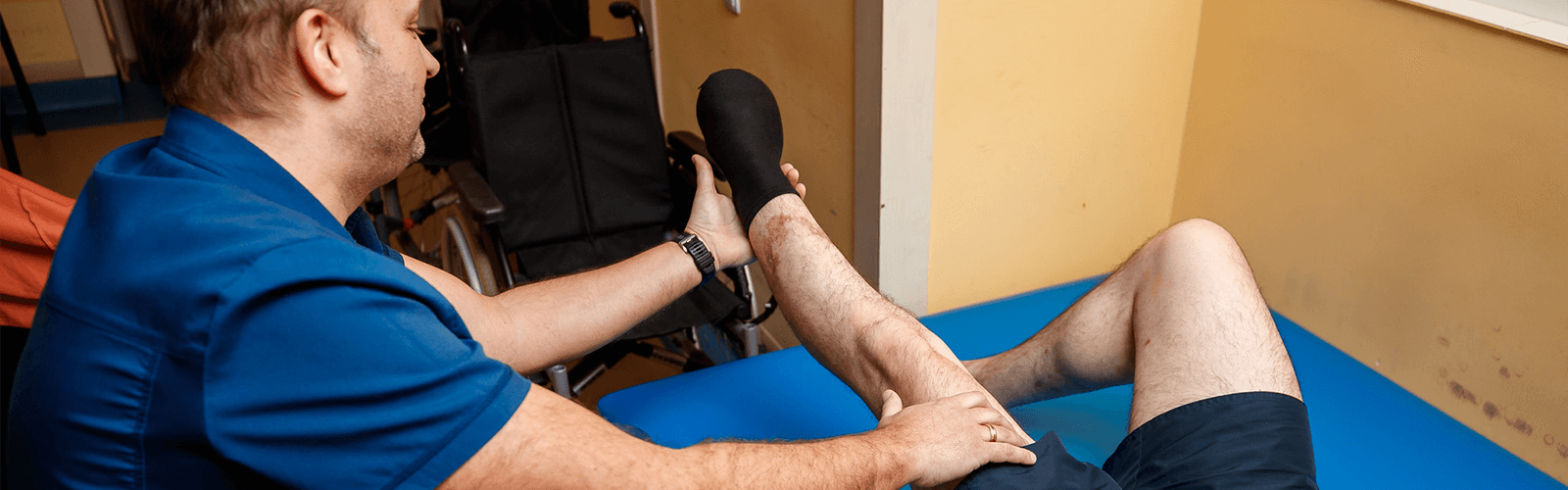

Ukraine’s Ministry of Health estimates more than 250,000 people will require rehabilitation services each year. Results for Development is supporting policymakers to strengthen health financing policies to expand access to quality, affordable rehab services.
The Challenge
Russia’s full-scale invasion of Ukraine has dramatically increased demand for rehabilitation services and underscored the need to strengthen the physical rehabilitation sector. The steep rise in conditions such as spinal cord injuries, amputations and complex limb trauma – combined with an already limited rehabilitation workforce, broad disruptions to health service delivery, and insufficient access to assistive technology (AT) – is impacting the Government of Ukraine’s ability to respond.
The Ministry of Health and the National Health Service of Ukraine (NHSU) are working to strengthen their stewardship roles to coordinate financing, promote strategic purchasing, and plan for both the short- and long-term rehabilitation needs of the Ukrainian population. At the same time, the government is working toward implementation of the National Strategy for Creating a Barrier-Free Environment, which requires structural reform across the rehabilitation system.
The Opportunity
Sustainable, quality, physical rehabilitation services will enable Ukrainians to restore their functional abilities, re-integrate within society, and participate in the economic recovery and growth of the country. This means not only improving clinical care but also expanding access to assistive devices, strengthening the rehabilitation workforce, and empowering veterans and people with disabilities to lead active lives in their communities.
The US Government-funded Rehabilitation for Ukraine (Rehab4U) project is a five-year initiative (2024–2029) working to establish a sustainable, effective, and person-centered rehabilitation system — integrating services across all levels of care within the Ukrainian health system. Rehab4U is led by Momentum Wheels for Humanity (MWH), with support from R4D, Deloitte, the National Assembly of People with Disabilities of Ukraine and Project Hope.
R4D’s Work
Under the Rehab4U project, R4D is supporting the Government of Ukraine to strengthen the efficiency, quality, and strategic purchasing of rehabilitation services in the context of rapidly increasing demand driven by the ongoing war. R4D developed a robust costing methodology tailored to Ukraine’s evolving rehabilitation service delivery model and NHSU priorities, drawing on stakeholder consultations, a review of legislation and international best practices, and extensive analysis of NHSU eHealth data. In collaboration with partners, R4D analyzed detailed cost data linked to hundreds of thousands of anonymized patient rehabilitation care records. R4D developed and validated a top-down rehab costing model, producing granular cost estimates across service types, complexity levels, age groups, and provider categories.
These results — validated with NHSU — are now being applied to refine rehabilitation payment mechanisms, including refining base rates, updating relative cost weights, and ongoing analysis of cost variation across diagnoses and populations. Future work will extend the costing model to priority disease-specific service packages that require intensive rehabilitation services (such as acute stroke and acute myocardial infarction) to inform integrated payment design. R4D’s budget simulation models will also help the government make informed resource allocation decisions. Overall, these analytics help ensure that provider payments for rehab care accurately reflect service complexity and performance.
Finally, R4D also contributes to advancing strategic purchasing practices through technical workshops, analytical papers, and ongoing engagement with key health financing and service delivery stakeholders. Our advising helps ensure that financing system decisions are aligned with population needs, system capacity, and international best practices.
This publication is made possible by the generous support of the United States Government. The contents are the responsibility of Momentum Wheels for Humanity and do not necessarily reflect the views of the United States Government.