
Can Local Experience Improve National Health Policy?
[Editor’s note: This is the fifth blog in R4D’s series on realistic health system design and planning. The series began by identifying seven factors that enable more realistic and implementable health system reforms, then explored how these principles are playing out in practice — from Argentina’s Programa Sumar to Ghana’s Free Primary Health Care reform and insights from a global convening on implementing reforms under constraints. This blog is co-authored by the Asia Health Policy and Systems Research Initiative and explores the development of a policy feedback loop in the decentralized context of Indonesia.]
In large, decentralized countries, national health policy is interpreted and implemented by officials at many different levels, from provinces and districts to individual health facilities. At each step, the policy may be adapted to local realities. But what local officials learn through implementation does not always make its way back to national decision-makers. That can make it hard to understand what is working, what is impeding progress, and what may need to change.
Indonesia’s health system clearly illustrates the challenges of decentralized policy implementation. Thirty-eight provinces and 514 districts and cities hold primary responsibility for health service delivery, while national leaders in the capital Jakarta set the national policy direction. Reporting systems capture what was delivered — service delivery outputs, coverage rates, and prevalence figures — but not how policies were implemented, what obstacles arose, or why results differ so widely between regions. Participatory national-subnational planning forums such as the musrenbang exist, but meaningful subnational input into policy evaluation remains limited.
Indonesia’s Health Development Policy Agency (BKPK), within the Ministry of Health, is working with Results for Development (R4D) and Universitas Gadjah Mada (UGM) to address these challenges by building and testing a structured, two-way policy feedback mechanism.
Why better policy feedback is needed in Indonesia
Two national shifts make this initiative particularly important right now.
The first is institutional. In 2022, the Ministry’s long-standing research and development agency, Balitbangkes, was transformed into BKPK, with a primarily policy stewardship role. Staff who had spent careers running national surveys were reclassified as “policy analysts.” That shift changed what the institution was expected to do with evidence — no longer simply generating and publishing it but using it to inform policy. A feedback mechanism is one concrete way that the implementation mandate can be translated into operational practice.
The second is fiscal. Indonesia’s 2023 Health Law removed previous mandates that automatically allocated 5 percent of the national budget and 10 percent of subnational budgets to health. A health sector master plan is planned to replace those mandatory health spending requirements, with greater emphasis on needs-based planning and better alignment between national and subnational priorities. With more discretion to allocate resources now sitting with local leaders, and fiscal envelopes becoming tighter across levels of government, feedback loops and closer national–subnational coordination have become more important than ever.
Using existing systems to strengthen health policy feedback
BKPK, R4D, and UGM co-designed the policy feedback mechanism with representatives from three provincial health offices, six district health offices, and local health policy and systems research institutions, including universities.
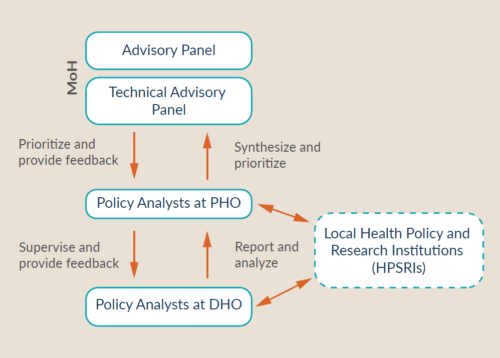
The design deliberately works through existing governance structures. Districts, coordinated by district health office (DHO) policy analysts and working alongside local health policy and systems research institutions and other government sectors, assess how a specific health policy is being implemented locally using a policy feedback instrument. Provinces then synthesize the insights across districts. The Ministry receives this synthesis through two tiers of advisory structures: a Technical Advisory Panel (TAP) that analyzes and translates the feedback into prioritized recommendations, and an Advisory Panel that brings key priorities to Ministry leadership. The TAP is intended to channel MoH feedback back to the provinces and districts through the same pathway, although this part of the mechanism is still under development.
Indonesia’s Policy Feedback Mechanism
To gather policy feedback, UGM and R4D adapted a structured scoring instrument covering four domains — how a given policy is communicated, translated into local regulation, implemented, and evaluated. Each score must be backed by evidence, such as regulations, budget documents, or performance data, which is synthesized in a policy memo. The instrument was adapted from the policy quality indicator tool developed by Indonesia’s National Institute of Public Administration, which officials are likely to be familiar with.
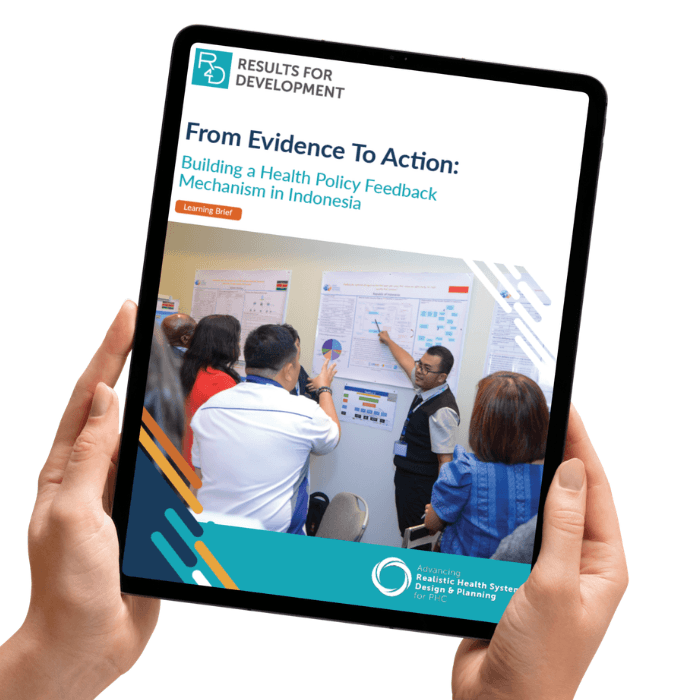
Further details on the model can be found in Indonesia’s learning brief here.
For the pilot phase of this mechanism, topics were decided through a consultative process. The four-month pilot cycle was implemented across West Java, West Nusa Tenggara, and South Sulawesi provinces and focused on nutrition policy.
Early lessons from Indonesia’s policy feedback pilot
Early implementation revealed four lessons about building trust, using local evidence, and sustaining coordination across levels of the health system.
- Collaborative reflection helps contextualize policy implementation issues and challenges. Bringing diverse government agencies and academic institutions into the same conversation consistently generated richer insights than any single institution could produce alone. Indonesia’s policy to reduce childhood stunting illustrates an important example. Multiple sectors share the same goal and are formally coordinated under an “acceleration team,” yet in practice, each often works independently toward sector-specific targets while the overall outcome stalls. That disconnect is difficult to see when each sector assesses its own performance.
- Local health policy and systems research institutions can strengthen local government health offices’ capacity to generate and use implementation evidence. In South Sulawesi, a district health office used university findings on antenatal care coverage to define a specific policy problem. In West Java, university participation helped district officers identify implementation gaps and think through policy responses. This intermediary role — supporting government health offices to interpret evidence and translate local experience into something policy-actionable — turns out to be as valuable as the research itself.
- Co-creation and small-scale implementation can help build trust between subnational governments and health policy and systems research institutions. In Sukabumi and Takalar districts, DHOs had previously partnered with only one or two familiar universities. The pilot widened that network and gave both government and academia a clearer sense of what the other party could offer. Post-workshop feedback pointed to growing mutual trust and a more positive view of academic partners’ credibility in the health system. Early implementation also suggests repeated engagement and iteration play an important role in trust-building.
- Feedback mechanisms require practical arrangements for sustained coordination and collaboration. Competing workloads, institutional priorities, and established ways of working can make regular joint engagement difficult. Challenges have emerged in each province, including reluctance to participate without a formal MOU, inconsistent participation, and the need for more frequent meetings to build a shared understanding of the mechanism’s purpose. Where no formal structure is yet in place, someone needs to take the initiative to bring stakeholders together. In Bandung, for example, the DHO took the initiative to convene other government offices to jointly complete the assessment.
- Better alignment of national and subnational capacity for policy analysis and evaluation is needed. With BKPK’s new mandate, it has created policy analyst roles at subnational level, but the necessary capacity to fill them has not developed evenly. Given how program-focused government health offices in Indonesia have historically been, most subnational personnel are more familiar with program reporting than policy analysis. The pilot provides an important learning opportunity and platform for closing that gap.
- Several factors seem to be enabling the success of this feedback mechanism. These include: building on existing government infrastructure rather creating parallel ones; starting with a narrow set of policy topics and a small-scale implementation; and building trust and coordination among provinces, districts and health policy and systems research institutions.
Moving from one-way feedback to a full policy feedback loop
Early implementation has focused on one-way feedback from district to national level, but has not yet documented positive evidence that something raised at the district level changed something at the national level. Strengthening feedback from national to district level is the next critical test for the mechanism, which we will explore in the next phase through March 2027.
A forthcoming brief will examine how the mechanism performs in full cycle across the three provinces and what this reveals about connecting policy and implementation in one of the world’s largest decentralized health systems.
This blog was developed with support from two projects at R4D. The Asia Health Policy and Systems Research (HPSR) Initiative brings together HPSR institutions across South/Southeast Asia, including Indonesia, to strengthen the HPSR ecosystem and bridge the gap between evidence generation and policy uptake. The Advancing Realistic Health Systems and Design Planning (HSDP) project supports countries to implement primary health care reforms by integrating evidence-based planning and strategic use of resources to make progress on universal health coverage goals. Both projects are funded by the Gates Foundation.